Optical Character Recognition Powers the Live Casino Data Layer
Watching a live blackjack dealer through a phone can make the technology seem straightforward. A camera films a real table, the stream travels across the internet, and players interact through buttons layered over the video.
The reality is much more complicated.
The platform needs to understand what is physically happening at the table. Cards must become digital values, game states must stay aligned with the video, player actions need to reach the server at the correct moment, and results must remain verifiable afterwards. This is one reason Optical Character Recognition Powers an interesting part of live casino infrastructure.
OCR and related optical-recognition technologies act as translators between physical gaming equipment and software. They help transform something a dealer can see into information a computer can process, display, store, and check.
A Live Stream and a Data Stream Are Different Things
The first thing to understand is that live casino games usually need more than video.
Video answers the human question:
“What is happening at the table?”
Structured data answers the computer question:
“What event just happened?”
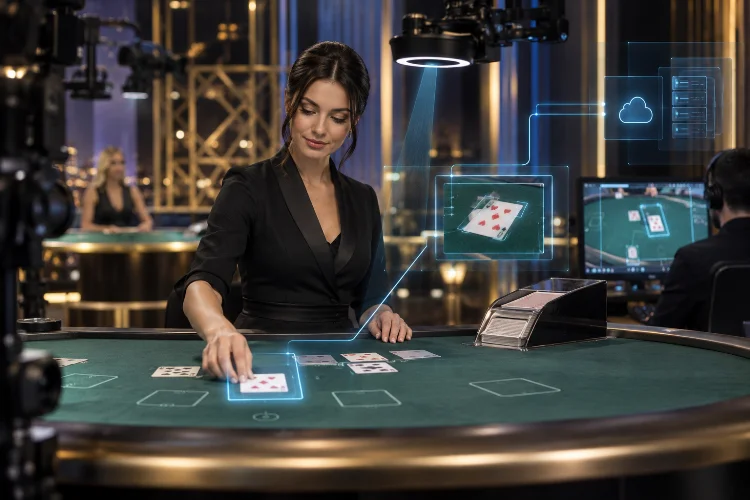
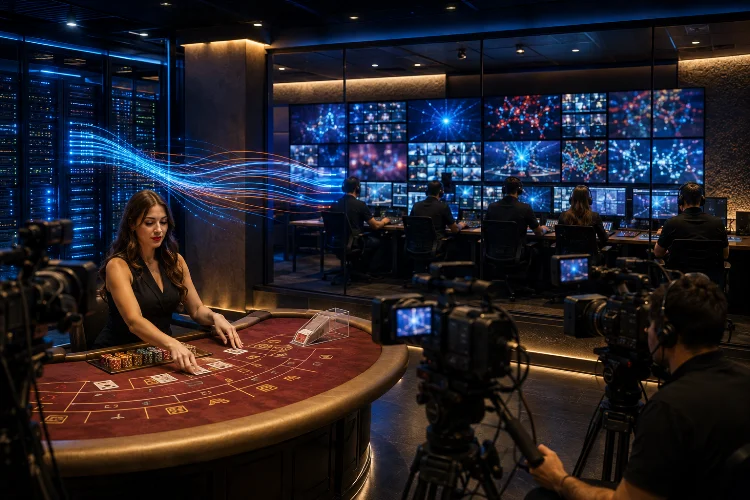
A remote casino system may transmit a live view of a dealer while game information travels separately through software systems. Patented remote gaming architectures describe physical cards and casino equipment being used at a live table while players view a video feed from remote terminals.
Another casino technology patent describes card recognition running alongside a camera feed, with both data types transmitted to a player’s device.
Those two channels have to agree.
If the video shows an ace but the interface thinks a ten was dealt, the game has a serious state mismatch.
Optical Recognition Creates Structured Game Events
A camera captures pixels.
A gaming server needs something more structured.
For a card game, useful information might look conceptually like:
Card 1 → Ace → Spades → Player Hand
General computer-vision OCR platforms already demonstrate how visual recognition can return characters, locations, and confidence information rather than simply producing another image. Google’s ML Kit, for example, structures recognised text into blocks, lines, elements, and symbols.
Casino recognition systems adapt the same broad concept to a much narrower environment.
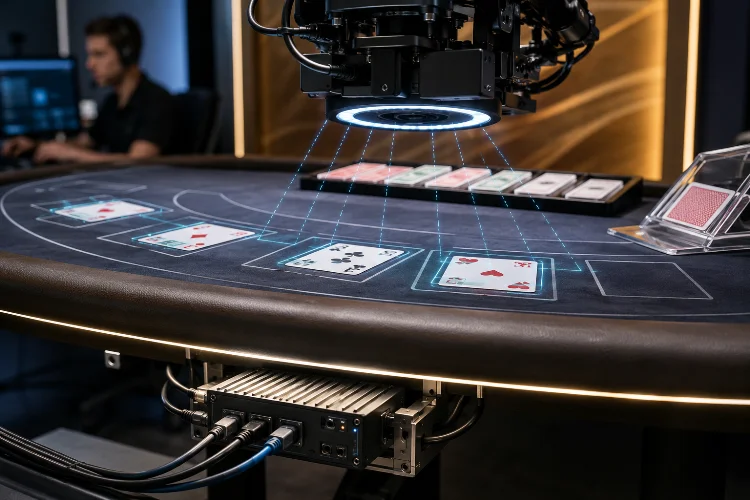
A shoe or optical reader may identify the rank and suit of a card as it passes through a controlled reading area.
A patent for a casino monitoring system specifically describes OCR inside a baccarat shoe used to identify card rank and suit during dealing.
Once the system has that value, the physical action becomes a software event.
Controlled Hardware Makes Recognition More Reliable
Casino card recognition has an advantage over many everyday OCR problems: the environment can be heavily controlled.
Imagine trying to recognise a playing card from a tourist’s random smartphone photograph.
The image might contain shadows, glare, motion blur, unusual angles, fingers covering the corner, or unrelated objects in the background.
A dedicated casino reader can reduce those variables.
Cards can pass through a fixed position. Lighting can remain consistent. Sensor distance can be predetermined. Card designs can also follow known specifications.
These details matter because recognition quality is heavily influenced by the quality and geometry of the input image.
AWS documentation for optical document processing recommends providing optimal input material and using recognition confidence scores rather than blindly assuming every detected value is correct.
The same engineering principle applies to any high-reliability optical system: make the input predictable before trying to make the algorithm cleverer.
Confidence and Validation Matter in Financial Games
OCR systems do not merely need to recognise something.
They need to know how certain they are.
Imagine the system thinks a card is either a six or an eight because part of the symbol is obscured.
An ordinary consumer application might simply choose the most likely answer. A regulated financial gaming environment needs stronger handling of uncertainty.
Confidence scoring can help software distinguish between a normal recognition and an uncertain one. Google’s OCR tooling, for example, exposes confidence information alongside detected elements.
A robust gaming architecture can then apply additional validation.
Does the recognised value fit the physical card event? Did two sensors report the same thing? Does the dealer action match the detected state? Does the game logic consider the round complete?
The exact process varies between systems, but the principle is important.
Recognition should be treated as an input that can be verified, not as an infallible oracle.
OCR Can Trigger Automatic Interface Updates
One of the most visible benefits appears on the player’s screen.
Suppose the dealer draws a seven.
The physical reader identifies it. The recognition layer sends the value to the table-management software. The game engine assigns it to the correct hand. The player’s interface then displays the updated card and total.
A card-handling patent describes processors receiving recognised rank-and-suit information, determining which cards belong to each hand, and presenting that information on a display.
That process eliminates much of the need for constant manual data entry.
It also helps the interface respond quickly enough to feel connected to the physical table.
The result is what players experience as one seamless product even though several seperate technical systems may be working underneath it.
Latency Is a Data-Synchronisation Problem
Live casino latency is often discussed as a streaming issue.
That is only part of it.
The video can arrive quickly while the game data arrives late, or the data can arrive first while the video is delayed.
Either case creates a poor experience.
The platform therefore needs to maintain timing between the video stream and the event stream.
This matters particularly when players have a limited time to choose an action. A blackjack player might need to hit, stand, double, or split during a specific decision window.
The full sequence can involve:
dealer action → optical detection → interpretation → game-server update → interface rendering → player response.
Every stage adds a small amount of processing or network delay.
The technical objective is not necessarily zero latency—it is consistent and correctly ordered latency.
A slightly delayed but syncronized game can be more understandable than one where video and digital state repeatedly disagree.
Structured Data Supports Automated Game Logic
Once physical events become reliable digital data, software can do more than display them.
It can process game rules.
A baccarat recognition system, for example, can pass detected card values to a rules module that determines the result of the round. Such architecture has been described in casino-monitoring patents covering recognition-enabled card shoes.
In blackjack, software can calculate hand totals.
In baccarat, it can interpret Player and Banker outcomes.
In other table games, structured data can help identify round stages, winning positions, or payout conditions.
This does not mean OCR replaces the dealer.
The dealer still conducts the physical game.
Recognition makes those physical events understandable to the software surrounding the dealer.
Game Histories Become Easier to Reconstruct
One of the less visible benefits of machine-readable gaming events is record keeping.
A video file is useful evidence, but analysing it can require a human to watch the footage.
Structured data can be searched much more efficiently.
A system might store information such as:
Round ID → cards dealt → hand assignment → result → timestamp.
Casino card-handling patents describe maintaining histories containing card information across multiple rounds.
This becomes particularly useful when combined with video surveillance.
UK Gambling Commission technical standards state that live-dealer operations must be fair and independently auditable. They also require appropriate surveillance and game logs that can be analysed for operational trends.
Digital recognition can contribute to that audit trail by creating a searchable record of physical game events.
OCR Is Part of a Wider Sensor Ecosystem
Calling every card-detection technology “OCR” would oversimplify the industry.
Dedicated casino equipment can use multiple approaches.
Patented systems describe conventional optical rank-and-suit recognition, ultraviolet or infrared markings, barcodes, magnetic coding, embedded electronics, and RFID tags.
The best technology depends on the equipment and game.
Optical character recognition works naturally when visible symbols need to be interpreted. RFID may be useful where objects contain embedded identifiers. Roulette wheels can use dedicated sensors. Other equipment may combine several detection methods.
This technical diversity is important because modern live casino infrastructure is not based on one magical camera.
It is a network of sensors, software, video systems, databases, and validation processes working together.
OCR simply provides one of the key bridges between physical reality and digital information.
Optical Character Recognition Powers more than automatic card reading in live casino technology. It can feed game logic, update interfaces, maintain digital histories, and help physical events stay connected with streamed gameplay.
Look beyond the dealer and cameras, and the real technical challenge becomes clear: every physical action must become accurate, timely, verifiable data without making the live experience feel artificial.