What Is Optical Character Recognition and Why Live Casinos Use It
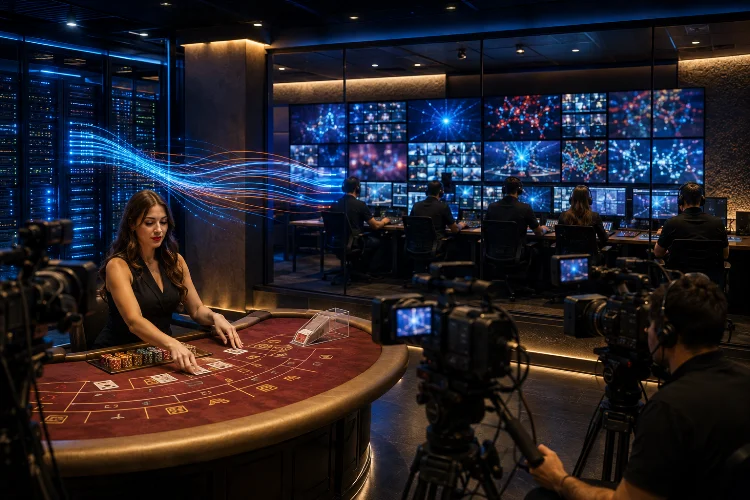
A live casino has an unusual technical problem. The cards, roulette wheel, and dealer exist in a physical studio, but bets, balances, statistics, and payouts exist inside software. Somehow those two worlds need to stay synchronized.
That is where recognition technology becomes important. What Is Optical Character Recognition, and why does it appear so often in explanations of live dealer games?
At its core, OCR converts visual information into data a computer can understand. In a live gaming studio, that basic idea can help identify cards and feed physical results into the digital game system with very little manual input.
OCR Creates a Digital Version of a Physical Event
Think about what happens during one blackjack deal.
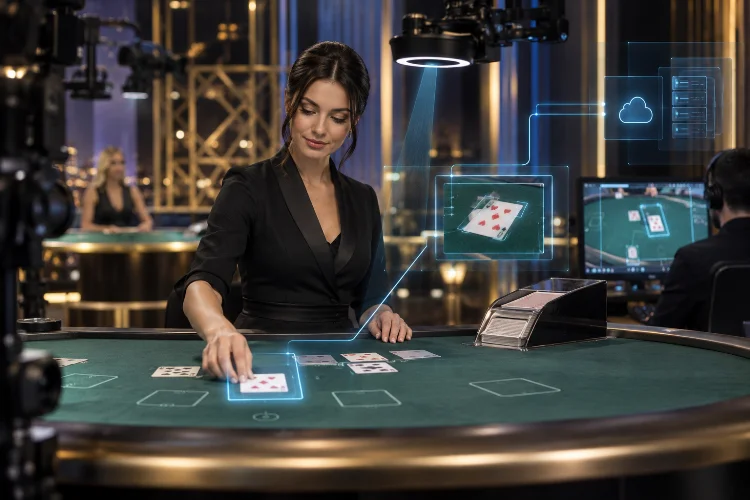
The dealer removes a physical card from the shoe and places it on the felt. A camera shows that card to the player, but simply broadcasting the picture is not enough.
The game software also needs to know which card appeared.
If the dealer reveals a 6 of diamonds, the digital system may need that information to update the hand total from 10 to 16, determine which actions remain possible, store the card in the round history, and eventually settle the wager.
OCR was originally developed to convert characters visible in images into machine-readable information. IBM explains that the technology can process scanned documents and camera images, identify characters, and convert them into digital data.
In a casino context, the same principle can be narrowed to a highly controlled set of visual objects such as card ranks and suits.
Live Casino OCR Is More Controlled Than Document Scanning
Reading a playing card is quite different from digitising a 40-page document.
A document can contain thousands of words, unusual fonts, paragraphs, stains, handwriting, and unpredictable layouts.
A playing-card recognition system deals with a far smaller universe.
There are only 13 ranks and four suits in a normal 52-card deck. The camera can also be positioned toward a known reading area under carefully controlled studio lighting.
Technical descriptions of live card-recognition platforms show cameras being calibrated to defined table locations, with recognition software automatically identifying and validating card values.
That controlled setup can reduce uncertainty considerably.
Instead of asking, “What does this entire image say?” the system may essentially ask, “Which one of these known card patterns is currently inside this specific area?”
The task is narrower, but its required reliabilty is extremely important because real wagers may depend on the result.
OCR, Computer Vision, and Card Scanners Are Not Exactly the Same
The terminology used in live casino articles can sometimes become blurry.
OCR specifically refers to recognising visible characters or symbols. Computer vision is a broader field that can identify objects, positions, movement, shapes, and relationships inside an image.
A modern studio may use both.
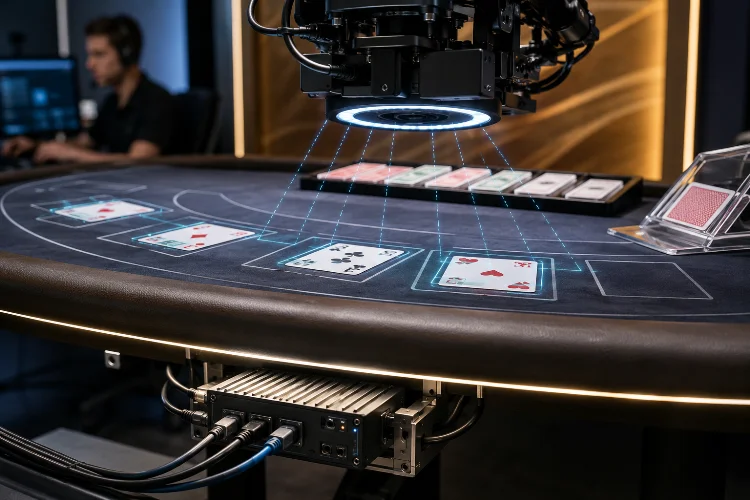
Computer vision could help locate a card within a camera frame, while OCR identifies the rank printed in the corner. Other systems may use dedicated card scanners or specialised shoe hardware instead of relying purely on a normal video feed.
GameShowMasters describes its technology stack as including optical card recognition, roulette ball tracking, automated shuffle detection, and connected recognition hardware.
That is a useful reminder not to assume every digital result appearing beside a livestream comes from exactly the same device.
“Recognition technology” is often a more accurate umbrella term.
OCR is an important part of that category, but the full live casino system can include several seperate sensing and processing technologies.
How the Information Moves From Card to Screen
Consider one baccarat card moving through the system.
First, the physical card becomes visable to the recognition hardware. A camera or scanner captures the relevant part of the card.
Recognition software identifies its rank and suit.
That result is then converted into structured data – something like “8 of hearts” represented in a format the game engine understands.
The game server can now apply baccarat scoring rules and update Player or Banker totals.
Meanwhile, the video feed continues showing the real dealer and physical card.
Live casino technology explanations describe table-level control equipment, often called a Game Control Unit, as part of the infrastructure connecting game events, video encoding, and the digital interface.
The player eventually sees one combined experience: physical video plus software-generated information.
Behind the scenes, however, they are distinct data streams that have to remain synchronized.
Why Recognition Technology Reduces Manual Data Entry
Without automatic recognition, somebody or something would have to tell the game software what happened after every physical action.
Imagine an employee manually entering every blackjack card.
That process could be slower and create opportunities for typing mistakes.
OCR exists partly to automate this conversion from physical information to digital data. IBM specifically notes that OCR reduces the need for repetitive manual data entry when extracting information from images.
The same general advantage applies in live casino technology.
Automated card recognition allows the game engine to recieve structured data directly from the recognition layer.
That does not remove humans from the operation.
Dealers still physically conduct the game, while supervisors, studio personnel, and technical systems monitor operations. The automation simply handles one specific information-transfer problem more efficiently.
OCR Helps Power On-Screen Features Players Barely Notice
A card appearing in a digital overlay is only the beginning.
Once the software knows what was dealt, many other features become possible.
A blackjack interface can display current totals. Baccarat software can update roadmaps and hand histories. Game records can list past results. Payout systems can identify the completed outcome.
Recognition data therefore acts as an input for the rest of the game engine.
Live gaming technology vendors describe connected presenter systems that combine automatic card detection with card history, game-flow management, rules engines, and statistics.
The OCR layer itself is not calculating every interface feature.
Rather, it provides trustworthy input that other software modules can use.
Think of it like a keyboard for the physical table: instead of a person typing “King of Hearts,” the recognition system enters that information automatically.
What About Errors and Disputed Results?
No responsible system should assume that automated recognition can never encounter a problem.
A card could be partially covered. A camera could experience glare. Equipment can malfunction. A connection might be interrupted.
This is why live casino integrity involves more than OCR alone.
The UK Gambling Commission requires licensed live dealer operations within its scope to be fair and independently auditable. Its technical standards call for equipment monitoring, dealer training, supervision, video surveillance, controlled access, and game logs.
The Commission’s wider testing framework also provides for technical testing and compliance audits of remote gambling systems.
That broader structure matters.
If something appears inconsistent, operators need records capable of helping establish what actually occurred.
Video, system logs, recognised results, and operational procedures can all contribute to that record.
OCR therefore supports game procesing, but it should not be mistaken for the entire fairness or audit framework.
Is OCR Responsible for the Actual Game Outcome?
Usually, the better way to think about it is that OCR records a physical outcome rather than creating it.
In a traditional live blackjack game, the card drawn from the real deck determines what happens. Recognition technology identifies that card so the software layer can respond.
Similarly, if optical or sensor technology is used around a roulette wheel, the physical ball and wheel create the result first. Detection systems then identify that result.
This distinction separates live dealer games from fully digital RNG-based versions of casino games.
A live game may still use software extensively, but software does not necessarily generate the underlying card or wheel outcome.
OCR is effectively translating reality into computer-readable information.
That is why the physical video and digital overlay should correspond closely.
If you can see an ace on the table, the interface should not tell you it was a seven.
Why OCR Speed Matters in a Live Game
Accuracy is essential, but live gaming also requires speed.
A dealer cannot reasonably stop for a long delay after every card while software tries to determine what it saw.
Modern recognition platforms are therefore designed for real-time or near-real-time operation. GameShowMasters describes sub-second processing as part of its live recognition technology.
The system also needs to remain synchronized with the broadcast.
This means recognition is part of a larger low-latency pipeline involving camera capture, video encoding, game servers, internet delivery, and the player’s device.
A fast OCR engine cannot solve every network problem, but slow recognition would add another delay to the chain.
The best implementation feels almost invisible: the dealer exposes a card, and the digital information follows naturally.
So, What Is Optical Character Recognition in a live casino? It is technology that can convert visible card information into structured digital data for the game system.
Modern studios may combine OCR with computer vision, scanners, sensors, game-control hardware, and auditing systems. Understanding those layers makes live dealer technology much less mysterious.
When you see physical cards and digital statistics updating together, you are seeing multiple recognition and software systems cooperating behind the stream.