Inside Live Casino Infrastructuren: What Game Control Units Actually Do
Press a button on a live roulette interface and the experience feels almost effortless. Your wager appears on the layout, the betting window closes, the dealer spins the wheel, the ball lands, and the result is displayed digitally. All of this happens while a live video feed continues running.
Behind that sequence is a combination of physical equipment and software. A particularly interesting component of Live Casino Infrastructuren is the Game Control Unit, or GCU. Industry sources describe GCUs as table-connected devices that help encode and transfer information from a live game into its online presentation.
The GCU is not the whole platform, but it helps solve one of live gaming’s hardest technical problems: turning real-world events into dependable digital states.
The Physical-Digital Gap Live Casinos Must Solve
Traditional online casino software can generate an entire game inside a computer system.
Live dealer gaming works differently because an important part of the game occurs physically.
Cards are dealt on a real table. A ball moves around a real roulette wheel. A dealer performs actions that players watch through video.
The software must therefore understand what is happening outside the software itself.
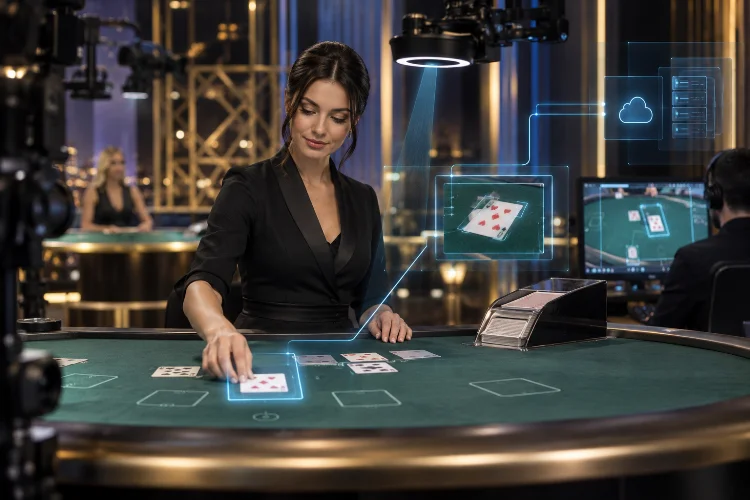
Industry descriptions explain that technologies such as optical recognition, sensors, scanners, and GCUs are used to convert table activity into data that can be displayed through the digital interface.
This creates a two-layer experience.
Players watch the physical event while simultaneously interacting with a digital betting system. For the game to feel coherent, both layers need to agree.
That agreement is one of the GCU’s most important operational roles.
From Dealer Action to Game State
Think about a blackjack card being dealt.
For the human viewer, recognising an ace of spades takes almost no effort.
Software needs structured information.
The card may be scanned or identified through recognition equipment, after which the relevant data becomes part of the current digital game state. Industry descriptions of live dealer technology say the GCU works with these systems to encode or relay what is happening at the table.
The same basic principle applies to other live games.
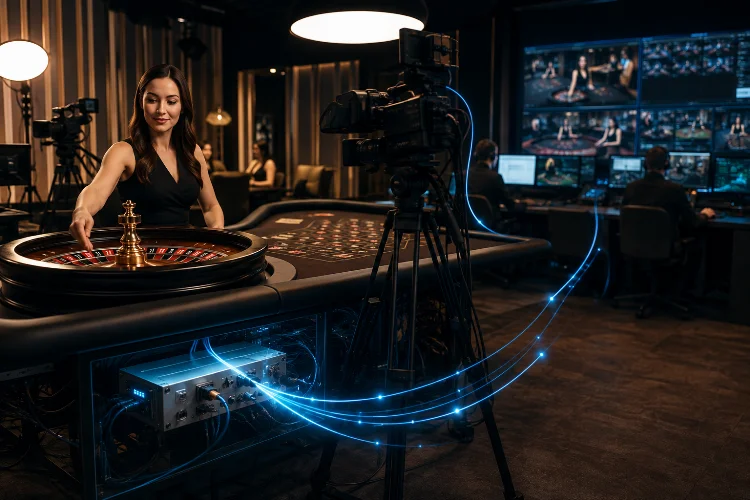
A roulette outcome might involve data from the wheel or recognition system. Baccarat requires cards to be associated correctly with player and banker hands. Other formats may involve physical devices, buttons, sensors, or dedicated dealer inputs.
The details vary, but the objective is consistent: physical information must reach software accurately and at the right moment.
Without that conversion layer, the broadcast would essentially be only a video.
Managing the Life Cycle of a Live Round
A live game is not just an outcome.
It is a sequence of states.
A simplified round might move through:
Betting open → betting closed → physical action → result confirmed → bets settled → next round
Each transition matters.
A player’s wager must be submitted before the correct deadline. The game should stop accepting new bets when the round closes. The final result must be associated with the right round rather than the one before or after it.
The GCU and surrounding table systems can help feed the information needed to coordinate these states, while backend software handles the broader transaction logic and player presentation. Industry sources describe GCUs as part of the link between dealer activity and the online platform.
This is why latency is more than a streaming-quality issue.
If video, game events, and betting states fall out of alignment, players can see information that does not appear to match what the interface allows them to do.
Reliable timing is therefore a core infrastructure problem.
Video Streaming and Game Data Are Different Workloads
A common misconception is that everything a player sees comes through a single video stream.
In practice, video and game-state information serve different purposes.
Video provides visual evidence of the dealer and table. Structured data tells the client application things such as current cards, winning numbers, round status, timers, and betting results.
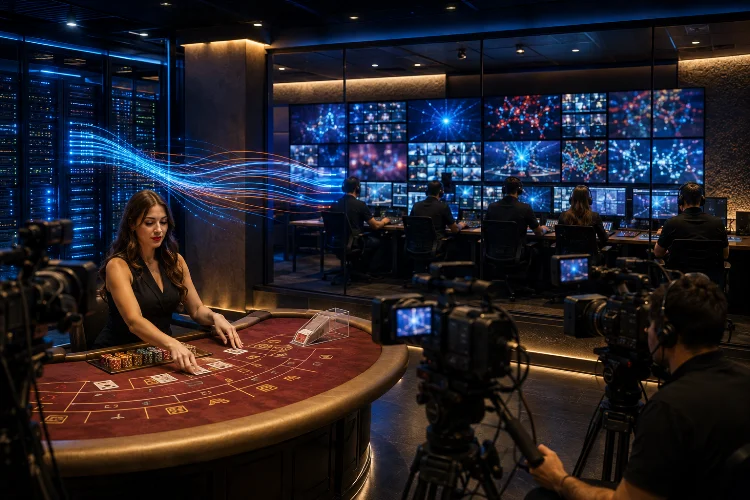
Industry explanations describe the GCU as operating alongside the live broadcast and recognition technology rather than replacing them.
That separation has practical advantages.
The platform can update interface elements using lightweight data instead of trying to interpret every important event directly from compressed video on the player’s device.
Meanwhile, cameras can focus on delivering a clear broadcast.
The two streams of information then need to remain synchronised.
This is technically demanding because networks are never perfectly uniform. Different viewers may experience different amounts of latency, yet the underlying game state still needs to stay authoritative.
Dealer Interfaces Provide Another Control Layer
The dealer sees more than the physical table.
Live studio descriptions commonly include dealer monitors or control displays that can show information about the current round, player activity, and betting status.
These tools help coordinate human activity with the digital system.
For example, the dealer may need a clear indication that betting has closed before beginning the decisive part of a round. They may also need system feedback if a card scan has not registered correctly.
This creates a useful feedback loop:
The dealer performs an action.
The table technology captures it.
The system processes it.
The dealer receives information confirming what should happen next.
Good infrastructure makes this process feel natural rather than forcing the dealer to manage complex software manually while presenting the game.
The difficult work stays largely invisibile to the audience.
Why Synchronicity Is a Testing Issue
When live casino systems are tested, visual quality is only one consideration.
Gaming Laboratories International says its live dealer testing can include technical tests, system tests, premises evaluations, staffing checks, responsibility tests, and specifically synchronicity tests.
That word is especially important for understanding GCUs.
A correct result delivered at the wrong time can still create a problem. Likewise, a perfectly clear video feed is not enough if the corresponding game information reaches the player incorrectly.
Testing therefore needs to examine relationships between components.
Does the displayed result match the physical table?
Are events recorded in the correct order?
Does the system respond properly when communications are interrupted?
Can unusual rounds be investigated afterward?
These are infrastructure questions, not simply visual-production questions.
Audit Trails Turn Live Events Into Verifiable Records
Live casino rounds happen quickly, but disputes may be investigated much later.
That means the platform needs more than transient screen information.
The UK Gambling Commission requires live dealer operations under its RTS framework to be fair and independently auditable.
Its compliance strategy also states that live dealer studios may require an audit where suitable equivalent auditing has not already been completed.
The GCU’s contribution to structured table data becomes particularly useful in this context.
When events are captured digitally, systems can potentially associate them with timestamps, round identifiers, transactions, and other operational records according to the provider’s architecture.
A technical team investigating an issue therefore has more than a video clip to consider.
It can compare different records and determine whether the digital settlement corresponded with the physical round.
Reliable logging is less glamorous than HD video, but it is arguably more important during an incident.
Security Protects the Whole Data Chain
The table is only the beginning of the data journey.
After leaving the studio equipment, game information may pass through servers, networks, platform integrations, and operator systems before reaching the player’s device.
The UK Gambling Commission states that licensed remote gambling systems must meet technical and security requirements, with its current security framework drawing on relevant ISO/IEC 27001:2022 controls.
GLI also performs security and vulnerability audits covering gaming systems and internal operating controls.
This means operators need to think beyond physical table security.
Access control, network integrity, configuration management, software changes, monitoring, and incident procedures can all matter.
Protecting the GCU while ignoring the backend connection would leave the broader architechture exposed.
The infrastructure is only as reliable as the chain connecting its components.
GCUs Make Modular Live Studios Possible
A modern studio can contain many tables operating simultaneously.
Treating each table as a distinct technical endpoint makes the system easier to manage.
One table may be dealing blackjack while another operates baccarat and several others run roulette sessions. Each generates its own event sequence, video feed, and player activity.
A table-level GCU provides a logical place for that individual physical game to connect with digital infrastructure. Industry sources commonly describe each operating table as having its own GCU or equivalent table-linked control equipment.
The backend can then aggregate many table feeds without treating the studio as one giant game.
This modularity also supports troubleshooting and maintainance.
If a sensor, scanner, camera, or control unit fails on one table, operations teams can isolate that problem more easily than if every table shared one undifferentiated control path.
For large live studios, that separation is an important engineering advantage.
Game Control Units help make Live Casino Infrastructuren practical by turning physical table activity into structured information the digital platform can use. They work alongside recognition systems, video, dealer interfaces, backend services, audit records, and security controls.
The next time a live round appears effortless, remember that the real achievement is keeping every technical layer synchronized behind the scenes.