
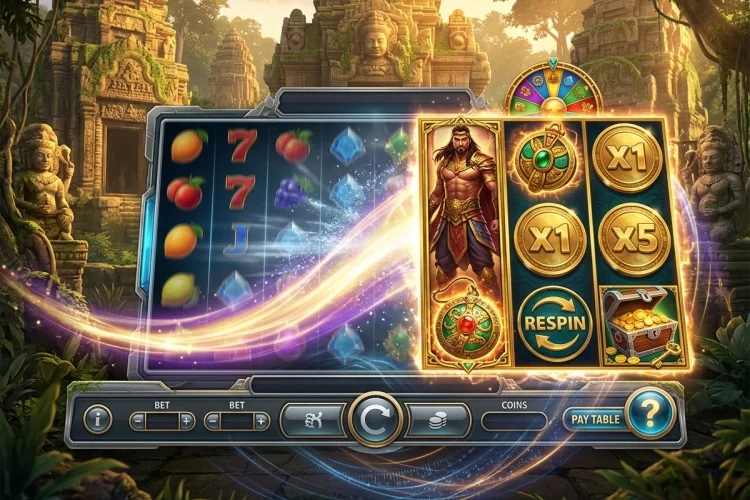
How Bonus Rounds Work in Online Slot Games: A Beginner’s Guide
The base reels suddenly fade, new symbols appear, and the game announces that a bonus feature has started.
Bonus rounds are among the most recognizable elements of modern online slots, but their colorful animations can make the underlying mechanics seem more complicated than they really are.
Understanding how bonus rounds work in online slot games begins with separating presentation from mathematics. A bonus round is usually an additional phase connected to the original paid spin.
It may award free spins, multipliers, respins, expanding wilds, selectable prizes, or access to a jackpot feature. The exact outcome remains governed by the game’s rules and random-number system.
Bonus features do not guarantee a profit or become more likely simply because they have not appeared recently. Their triggers and awards form part of the slot’s overall mathematical design.
Players should therefore read the pay table, check the theoretical return, and understand the triggering requirements before wagering. Slots should always be treated as paid entertainment rather than a dependable source of income.
What Is an Online Slot Bonus Round?
A bonus round is an additional game phase activated from the main slot game. It may begin immediately after a qualifying combination appears or after the game randomly awards entry according to its programmed rules.
Technical standards treat bonus games, including free-game features, as part of the wider game cycle. The rules, possible rewards, multiplier ranges, and triggering conditions should be clearly presented to the player.
A bonus does not always require another wager. In many free-spin rounds, the original triggering spin provides access to the feature, although designs and local regulations differ.
How Bonus Features Are Triggered
Scatter symbols are among the most common triggers. A game might require three or more scatters to appear anywhere on the reels, rather than along a standard payline.
Other slots use collected symbols, mystery triggers, special combinations, or progress meters. When a feature depends on collecting several objects, technical standards require the game to explain how many are needed and display the player’s current progress.
A near-trigger does not mean the next spin is more likely to activate the feature. Symbols appearing just short of the required combination may create excitement, but each new random game cycle is governed by the slot’s programmed probabilities.
What Happens During Free Spins?
Free spins allow the reels to spin a specified number of times without deducting the normal stake again. The value of each spin is usually based on the wager that activated the feature, although the help screen should confirm the exact calculation.
The bonus may use different reel strips, symbols, multipliers, or wild behavior from the base game. GLI standards state that changes in symbol function and symbols available only during a bonus should be disclosed in the game information.
Some games also permit retriggers. For example, landing additional scatters during the feature may add more spins, but the number awarded and any maximum limit depend on the published rules.
Pick Features, Respins, and Multipliers
A pick-and-win round asks the player to select from several objects, such as boxes, cards, or treasure chests. The selections may reveal fixed credit prizes, multipliers, or entry into another stage.
Respins hold one or more symbols in place while selected reels spin again. Other features may use cascading wins, where winning symbols disappear and new ones replace them within the same sequence.
Multipliers increase a qualifying prize by a specified amount. Players should confirm whether a multiplier applies to all wins, only one payline, a particular symbol, or the final accumulated feature total. Testing standards require multiplier instructions and payment methods to be clearly described.
How the RNG Controls Bonus Outcomes
Licensed online slots generally use a random number generator, or RNG, to produce unpredictable outcomes. The RNG may determine the base-game symbols, entry into a randomly triggered feature, and results occurring inside the bonus.
UK technical standards require RNG outputs to be acceptably random and unpredictable. They also prohibit adaptive behavior that changes future winning probabilities to compensate for what a particular player previously won or lost.
Pressing the spin button at a different moment or stopping the reel animation does not provide reliable control over the result. The visual sequence presents the selected outcome rather than creating a skill-based timing opportunity.
How Bonus Rounds Affect RTP and Volatility
Bonus awards can contribute to a slot’s total return to player, or RTP. GLI standards specify that bonus awards occurring within the base game’s cycle should be included consistently when calculating the program’s payout percentage.
A slot may allocate a significant portion of its theoretical return to infrequent bonus features. This can increase volatility, producing longer periods of small or absent returns followed by occasional larger payouts.
RTP is a long-term average, not a session forecast. The UK Gambling Commission explains that actual return can remain above or below theoretical RTP over limited samples, particularly when volatility is high.
What to Check Before Playing
Open the pay table or help section before placing a wager. Check the number of symbols needed, whether they must appear on specific reels, the number of free spins, retrigger rules, multiplier conditions, maximum win, RTP, and any jackpot eligibility requirements.
Game rules should be available before play and should explain prizes, payouts, and the likelihood or method of winning.
Use only operators licensed for your jurisdiction and games assessed under applicable testing requirements. In Great Britain, relevant licence holders must submit game and RNG test results through the regulator’s games register.
Bonus rounds are additional phases connected to the slot’s main game cycle. They may be triggered by scatters, collected symbols, random events, or specific combinations and can award free spins, respins, multipliers, pick prizes, or jackpots.
Their outcomes remain subject to the game’s RNG, pay table, and certified mathematical model.
Before playing, examine the complete bonus rules instead of focusing only on animations or advertised maximum prizes. Choose an affordable stake, set firm spending and time limits, and never continue simply because a feature appears “due.”
Use bonus information to understand the experience – not as a method for predicting wins – and stop as soon as the planned entertainment limit is reached.